Station weights
Station weights decide how much each station contributes to the stack of a node. Qseek calculates a weight for every pair of station and node in the search volume from their distance, see stacking and migration. For every node and phase, the weights are normalized to a sum of one. Close stations get full weight: they record small events with the highest phase confidence and constrain the location best. Distant stations are tapered.
| Station weights | Full weight | Taper |
|---|---|---|
DistanceWeights (default) |
The 4 closest stations | Gaussian, full width at half maximum twice the mean interstation distance |
DensityTaperWeights |
The 4 closest stations | As DistanceWeights; far away, each weight approaches the taper times the independent station count |
station_weights takes one of them. With null, all stations get the same weight.
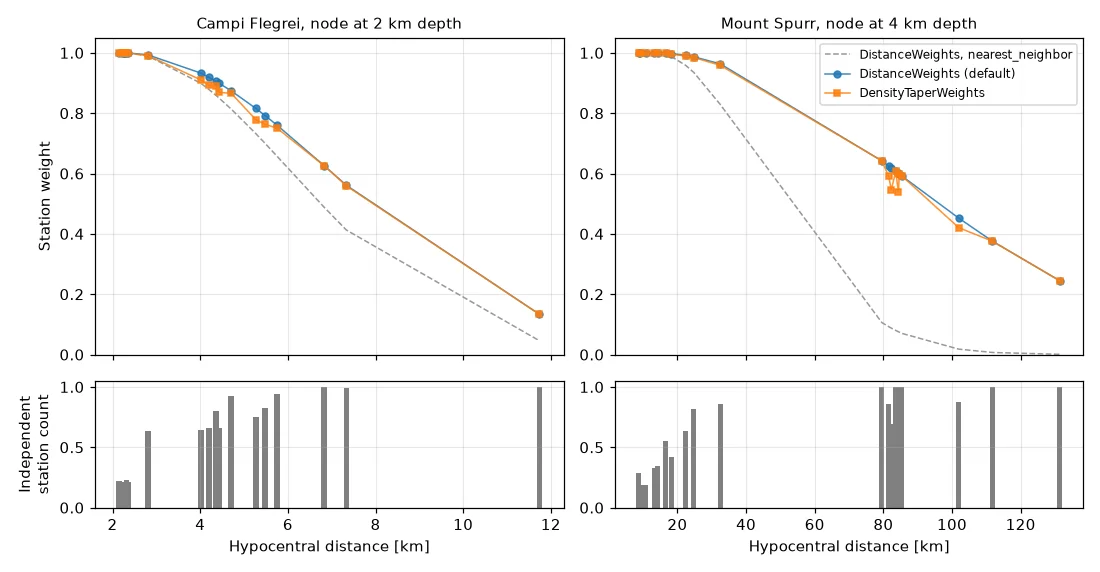
Station weights of a node, with the defaults, for two examples of the playground. Left: Campi Flegrei, 18 stations within 12 km, node at 2 km depth below Solfatara. Right: Mount Spurr, Alaska, node at 4 km depth below sea level beneath the volcano; ten local stations within 32 km and ten regional stations from 79 km to 131 km. Dashed: DistanceWeights with the taper "nearest_neighbor". Bottom: the independent station count of each station.
Choose the station weights
DistanceWeights, the default, locate best on the examples of the playground and suit most local and regional networks.DensityTaperWeightskeep the full weight of the closest stations and count a distant cluster of stations as its independent stations. Try them for a network with a dense cluster next to sparse stations. On the playground they locate as consistently asDistanceWeightsand find slightly more well-constrained detections where a cluster lies away from the seismicity.
The weights change from node to node, and they are normalized per node. A taper that falls off steeply between neighboring nodes therefore moves the locations as well: the stack prefers the nodes where the stations that recorded the event carry most of the weight. Keep the taper smooth. Over the distances where stations still record the events, the weights should decay as the phase confidence decays with distance. On the playground, a narrower taper and more or fewer stations with full weight both locate the detections less consistently than the defaults of DistanceWeights. The benchmark has the results.
Distance weights
The required_closest_stations closest stations of a node get full weight, 4 by default. More distant stations are tapered with a Gaussian function; distance_taper is its full width at half maximum, twice the mean interstation distance by default, "mean_interstation".
"nearest_neighbor" sets the taper to 6 times the median distance between neighboring station sites. On networks of similar station spacing it adapts the taper to the spacing: at Mount Spurr, where the regional stations widen the mean interstation distance, it moves the epicenters closer to the catalog. Do not use it for networks with a dense array: the spacing of the array sets the median.
{
  "weights": "DistanceWeights",
  "waterlevel": 0.0,
  "distance_taper": "mean_interstation",
  "required_closest_stations": 4
}
pydantic-model

Bases: StationWeights
The closest stations get full weight, more distant stations a Gaussian taper.
Close stations constrain the location of an event best. The taper width is absolute, the same for all nodes. With the defaults, these are the station weights of earlier Qseek versions.
Fields:
-
waterlevel(float) -
weights(Literal['DistanceWeights']) -
distance_taper(PositiveFloat | Literal['mean_interstation', 'nearest_neighbor']) -
required_closest_stations(PositiveInt)
pydantic-field

required_closest_stations: PositiveInt = 4
Number of closest stations of a node that get full weight. Only more distant stations are tapered, so that the closest stations contribute equally and the most to the detection and localization.
pydantic-field

waterlevel: float = 0.0
Minimum weight of distant stations, as a fraction of the full weight. With 0.0, distant stations do not contribute.
classmethod

fill_lut(nodes: Sequence[Node]) -> None
Calculate the node-station distances of nodes for the lookup table.
Parameters:
| Name | Type | Description | Default |
|---|---|---|---|
nodes
|
Sequence[Node]
|
Nodes of the octree. |
required |
Get the independent station counts of a set of stations.
The counts depend on the available stations, they are cached for each set of stations.
Parameters:
| Name | Type | Description | Default |
|---|---|---|---|
station_indices
|
ndarray
|
Indices of the available stations. |
required |
Returns:
| Type | Description |
|---|---|
ndarray
|
Array of shape (n_stations,) with values between 0 and 1. |
resolve_distance_taper(distance_taper: float | Literal['mean_interstation', 'nearest_neighbor'], stations: StationInventory) -> float
Resolve the width of a Gaussian distance taper for the stations.
Parameters:
| Name | Type | Description | Default |
|---|---|---|---|
distance_taper
|
float | Literal['mean_interstation', 'nearest_neighbor']
|
Full width at half maximum in meters,
|
required |
stations
|
StationInventory
|
Stations of the search. |
required |
Returns:
| Type | Description |
|---|---|
float
|
Full width at half maximum in meters, infinite with fewer than two station sites. |
async

Independent stations
Stations a few hundred meters apart record nearly the same waveforms and share the errors of the velocity model along their paths. DensityTaperWeights count how many independent stations each station is worth. An isolated station counts as one independent station, a station in a dense cluster as a fraction of one:
with the density \(k\) of the neighboring stations, a Gaussian kernel as wide as the median distance between neighboring sites, and the lowest and highest density of the network, \(k_\mathrm{min}\) and \(k_\mathrm{max}\). The densest station keeps \(k_\mathrm{min} / k_\mathrm{max}\), so every station counts. Sensors closer than 50 m, e.g. a broadband and a strong-motion sensor of one site, share a site and together count as the site. The counts are relative: they change when stations have no data in a window.
On Campi Flegrei, the 18 INGV stations count as 11.1 independent stations: the six stations in the center of the caldera, 200 m to 500 m apart, count as 0.2 each. At Mount Spurr, the 20 stations count as 13.8 independent stations, the ten local stations as 4.6. Qseek logs the count when the search starts.
Density taper weights
DensityTaperWeights start from the weight \(g\) of DistanceWeights and the independent station count \(c\) of each station:
The closest stations keep their full weight (\(g = 1\)), also within a cluster. Seen from a distance, the stations of a cluster record an event from nearly the same direction; with \(g\) falling off, their weight approaches \(g\, c^\beta\), so the cluster weighs as much as its independent stations. station_density is the exponent \(\beta\), 1 by default; with 0 these are the DistanceWeights. The weights change between nodes about as smoothly as the DistanceWeights.
On Campi Flegrei, the cluster of six stations lies above the seismicity and stays on the plateau for most detections: DensityTaperWeights locate as consistently as DistanceWeights. At Norcia, the cluster of 12 stations lies at about 28 km from the seismicity, beyond the plateau, where DistanceWeights give it nearly full weight; DensityTaperWeights count it as its independent stations and find more well-constrained detections. The benchmark has the numbers.
{
  "weights": "DensityTaperWeights",
  "waterlevel": 0.0,
  "distance_taper": "mean_interstation",
  "required_closest_stations": 4,
  "station_density": 1.0
}
pydantic-model

Bases: DistanceWeights
Distance weights that count distant clusters of stations as fewer stations.
The closest stations get full weight and more distant stations the Gaussian
taper of DistanceWeights. Seen from a distance, the stations of a dense
cluster record the event in nearly the same direction: in the taper, each
station's weight approaches its independent station count. The closest
stations keep their full weight, also within a cluster.
Fields:
-
waterlevel(float) -
distance_taper(PositiveFloat | Literal['mean_interstation', 'nearest_neighbor']) -
required_closest_stations(PositiveInt) -
weights(Literal['DensityTaperWeights']) -
station_density(float)
pydantic-field

station_density: float = 1.0
Exponent of the independent station count in the taper. A station in a dense cluster counts as a fraction of an independent station; with 1.0 a distant cluster weighs as much as its independent stations, with 0.0 these are the DistanceWeights.
pydantic-field

waterlevel: float = 0.0
Minimum weight of distant stations, as a fraction of the full weight. With 0.0, distant stations do not contribute.
pydantic-field

required_closest_stations: PositiveInt = 4
Number of closest stations of a node that get full weight. Only more distant stations are tapered, so that the closest stations contribute equally and the most to the detection and localization.
classmethod

fill_lut(nodes: Sequence[Node]) -> None
Calculate the node-station distances of nodes for the lookup table.
Parameters:
| Name | Type | Description | Default |
|---|---|---|---|
nodes
|
Sequence[Node]
|
Nodes of the octree. |
required |
Get the independent station counts of a set of stations.
The counts depend on the available stations, they are cached for each set of stations.
Parameters:
| Name | Type | Description | Default |
|---|---|---|---|
station_indices
|
ndarray
|
Indices of the available stations. |
required |
Returns:
| Type | Description |
|---|---|
ndarray
|
Array of shape (n_stations,) with values between 0 and 1. |
resolve_distance_taper(distance_taper: float | Literal['mean_interstation', 'nearest_neighbor'], stations: StationInventory) -> float
Resolve the width of a Gaussian distance taper for the stations.
Parameters:
| Name | Type | Description | Default |
|---|---|---|---|
distance_taper
|
float | Literal['mean_interstation', 'nearest_neighbor']
|
Full width at half maximum in meters,
|
required |
stations
|
StationInventory
|
Stations of the search. |
required |
Returns:
| Type | Description |
|---|---|
float
|
Full width at half maximum in meters, infinite with fewer than two station sites. |