Ray tracers
Ray tracers calculate the travel times from every node of the search volume to every station. ray_tracers is a list: every phase description in the phase_map of the image function needs one ray tracer that provides it.
| Ray tracer | Velocity model | Phases | Use for |
|---|---|---|---|
ConstantVelocityTracer |
Constant velocity | One per tracer, e.g. constant:P |
Tests and small volumes |
FastMarching |
1D layered | fm:P, fm:S |
Most searches in 1D models |
CakeTracer |
1D layered | Pyrocko phase definitions, e.g. cake:P |
Specific phases of 1D models |
FastMarching3D |
3D | One per tracer, e.g. fm3d:P |
Complex geology |
"ray_tracers": [
  {
    "tracer": "FastMarching",
    "velocity_model": {"filename": "velocity-model.nd"},
    "phases": ["fm:P", "fm:S"]
  }
]
Constant velocity
The travel time is the distance \(d\) divided by the velocity:
Each tracer provides one phase. Add one tracer for P and one for S.
{
  "tracer": "ConstantVelocityTracer",
  "phase": "constant:P",
  "velocity": 5000.0
}
pydantic-model

Bases: RayTracer
Travel times for a constant velocity: the distance divided by the velocity.
Useful for testing and for small volumes with little velocity variation.
Fields:
-
tracer(Literal['ConstantVelocityTracer']) -
phase(PhaseDescription) -
velocity(PositiveFloat)
pydantic-field

phase: PhaseDescription = 'constant:P'
Phase description of the travel times, e.g. "constant:P". The image function maps its phases to this description.
1D layered velocity model
Two ray tracers calculate travel times in 1D layered models. Both read the velocity model from a file in the Pyrocko Cake .nd format or the HYPOSAT format, or from a CRUST2.0 profile. Without a model, Qseek uses a default model and warns.
pydantic-model

Bases: Model
Config:
ignored_types:(cached_property,)
Fields:
-
filename(FilePath | None) -
format(Literal['nd', 'hyposat']) -
crust2_profile(Annotated[str, StringConstraints(to_upper=True)] | tuple[float, float]) -
raw_file_data(str | None)
pydantic-field

filename: FilePath | None = DEFAULT_VELOCITY_MODEL_FILE
Path to velocity model.
pydantic-field

format: Literal['nd', 'hyposat'] = 'nd'
Format of the velocity model. nd or hyposat is supported.
pydantic-field

Crust2 profile name or [lat, lon] coordinates.
Fast marching
The fast marching method solves the Eikonal equation for the first arrivals on a grid. It is faster than Pyrocko Cake for large numbers of stations and nodes.
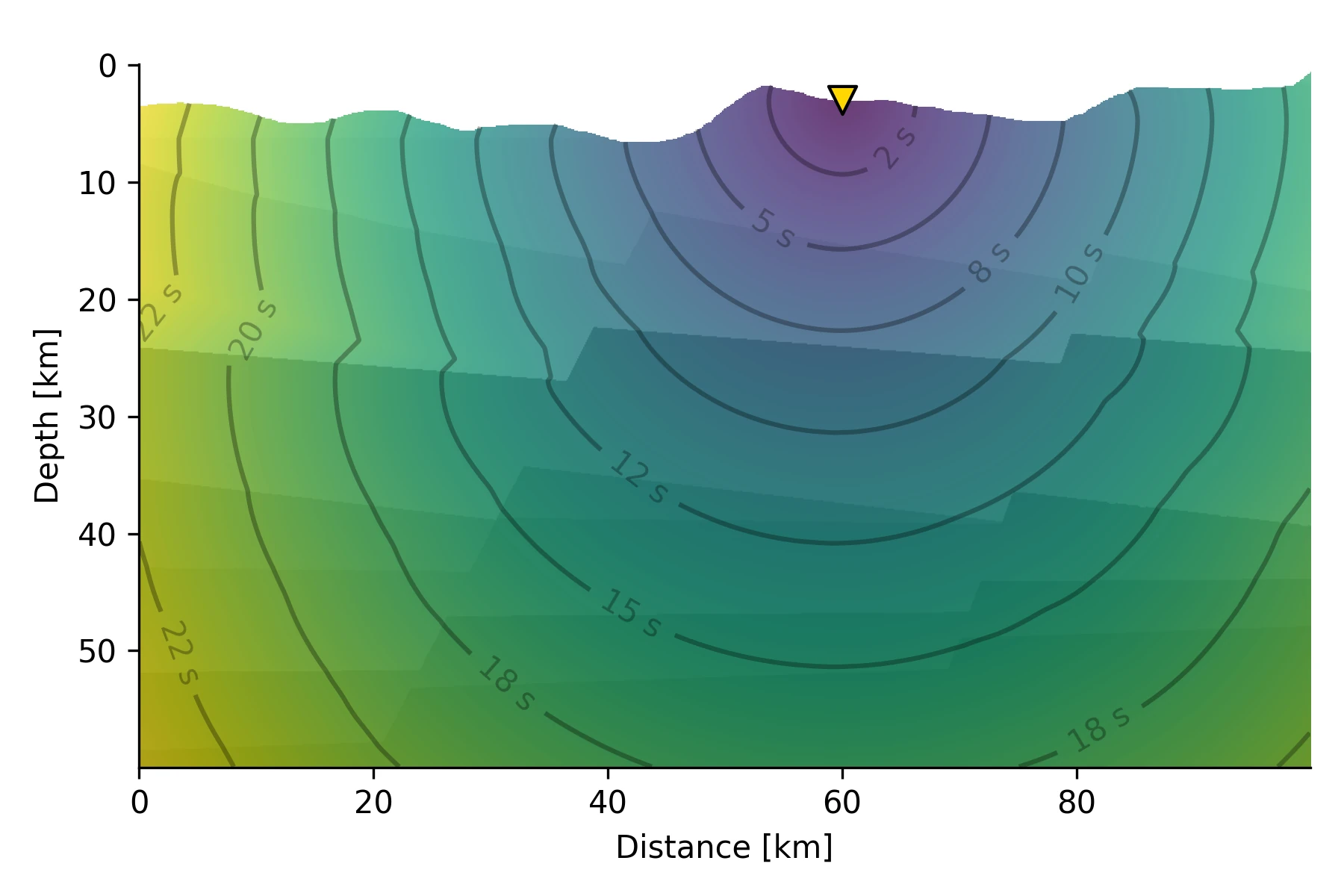
Travel times from a station at the surface (yellow triangle) to every point of a heterogeneous subsurface, calculated with the fast marching method. One calculation yields the travel times of a station to all possible source locations.
{
  "tracer": "FastMarching",
  "velocity_model": {
    "format": "nd",
    "crust2_profile": ""
  },
  "interpolation_method": "linear",
  "nthreads": 0,
  "implementation": "eikonalfm",
  "phases": [
    "fm:P",
    "fm:S"
  ]
}
pydantic-model

Bases: RayTracer
Travel times in a 1D layered velocity model from the fast marching method.
The fast marching method solves the Eikonal equation for the first arrivals on a grid. It is faster than the Pyrocko Cake ray tracer for large numbers of stations and nodes.
Fields:
-
tracer(Literal['FastMarching']) -
velocity_model(LayeredEarthModel1D | None) -
interpolation_method(InterpolationMethod) -
nthreads(int) -
implementation(FMMImplementation) -
phases(tuple[Phase, ...])
pydantic-field

velocity_model: LayeredEarthModel1D | None
Velocity model for the ray tracer.
pydantic-field

Interpolation of the travel times between the grid points.
pydantic-field

nthreads: int = 0
Number of threads for the travel time calculation. 0 uses twice the number of CPU cores.
pydantic-field

Implementation of the Fast Marching Method. Pyrocko only supports first-order FMM for now.
get_travel_time_table(
    location: Location, phase: Phase
) -> StationTravelTimeTable
Get the travel time table for a given station and phase.
async

prepare(
    octree: Octree,
    stations: StationInventory,
    rundir: Path | None = None,
) -> None
Prepare the tracer for a given set of stations.
Add a travel time slice to the tracer.
async

Get travel times for a phase from a source to a set of stations.
Parameters:
| Name | Type | Description | Default |
|---|---|---|---|
phase
|
Phase
|
Phase name. |
required |
nodes
|
Sequence[Node]
|
Nodes to get traveltime for. |
required |
stations
|
Sequence[Station]
|
Stations to calculate travel times to. |
required |
Returns:
| Type | Description |
|---|---|
ndarray
|
np.ndarray: Array of shape (n_nodes, n_stations) with travel times in seconds. |
Pyrocko Cake
The Pyrocko Cake ray tracer calculates the arrivals of phases given by Pyrocko phase definitions. "P,p" is the first P arrival, either the down-going P or the up-going p. The keys of phases are the phase descriptions, e.g. "cake:P".
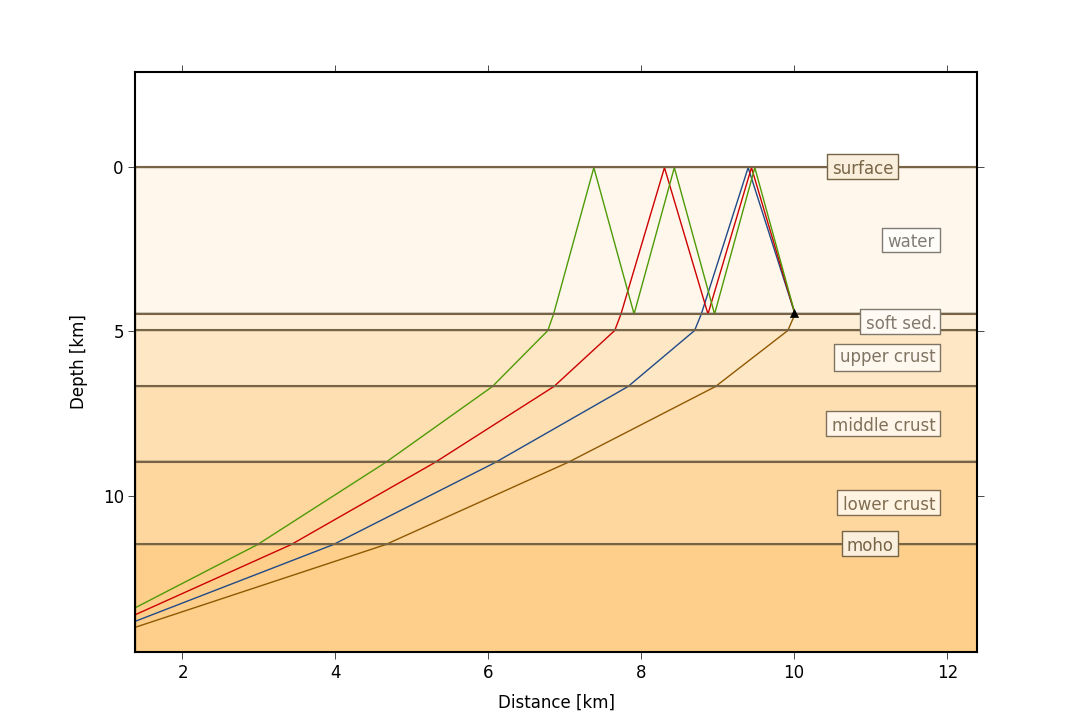
Rays of the Pyrocko Cake ray tracer in a 1D layered model.
{
  "tracer": "CakeTracer",
  "phases": {
    "cake:P": {
      "definition": "P,p"
    },
    "cake:S": {
      "definition": "S,s"
    }
  },
  "earthmodel": {
    "format": "nd",
    "crust2_profile": ""
  }
}
pydantic-model

Bases: RayTracer
Travel times in a 1D layered velocity model from the Pyrocko Cake ray tracer.
The phases are Pyrocko timing definitions, e.g. P,p for the first P arrival.
Fields:
-
tracer(Literal['CakeTracer']) -
phases(dict[PhaseDescription, Timing]) -
earthmodel(LayeredEarthModel1D)
pydantic-field

phases: dict[PhaseDescription, Timing] = {
    "cake:P": Timing(definition="P,p"),
    "cake:S": Timing(definition="S,s"),
}
Dictionary of phases and timings to calculate.
pydantic-field

earthmodel: LayeredEarthModel1D
Earth model to calculate travel times for.
3D velocity model
The 3D tracer calculates first arrivals with the fast marching method in a 3D velocity model. Each tracer provides one phase from one velocity model: add one tracer for P with a P-velocity model and one for S. Three velocity models are available:
- A NonLinLoc 3D velocity grid.
- A 1D layered model, extended to 3D.
- A constant velocity, mainly for testing.
{
  "tracer": "FastMarching3D",
  "phase": "fm3d:P",
  "interpolation_method": "cubic",
  "nthreads": 0,
  "velocity_model": {
    "model": "Constant3DVelocityModel",
    "grid_spacing": "octree",
    "velocity": 5000.0
  },
  "implementation": "eikonalfm"
}
pydantic-model

Bases: RayTracer
3D velocity model travel time calculation using fast marching method.
Fields:
-
tracer(Literal['FastMarching3D']) -
phase(PhaseDescription) -
interpolation_method(InterpolationMethod) -
nthreads(int) -
velocity_model(VelocityModels) -
implementation(FMMImplementation)
pydantic-field

Interpolation method for travel times in the volume. Choose from nearest, linear or cubic.
pydantic-field

nthreads: int = 0
Number of threads to use for travel time. If set to 0, cpu_count*2 will be used.
pydantic-field

Implementation of the Fast Marching Method. Pyrocko only supports first-order FMM for now.
pydantic-model

Bases: VelocityModelFactory
Fields:
-
model(Literal['NonLinLocVelocityModel']) -
header_file(FilePath) -
grid_spacing(PositiveFloat | Literal['octree', 'input']) -
interpolation(Literal['nearest', 'linear', 'cubic']) -
reference_location(Location | None)
pydantic-field

header_file: FilePath
Path to NonLinLoc model header file file. The file should be in the format of a NonLinLoc velocity model header file. Binary data has to have the same name and .buf suffix.
pydantic-field

grid_spacing: PositiveFloat | Literal["octree", "input"] = (
    "input"
)
Grid spacing in meters. If 'octree' defaults to smallest octreee node size. If 'input' uses the grid spacing from the NonLinLoc header file.
Visualize 3D models
For quality control, Qseek exports all 3D velocity models and travel time volumes as .vti files into the 3d-models/ folder of the run directory. Inspect them with ParaView.
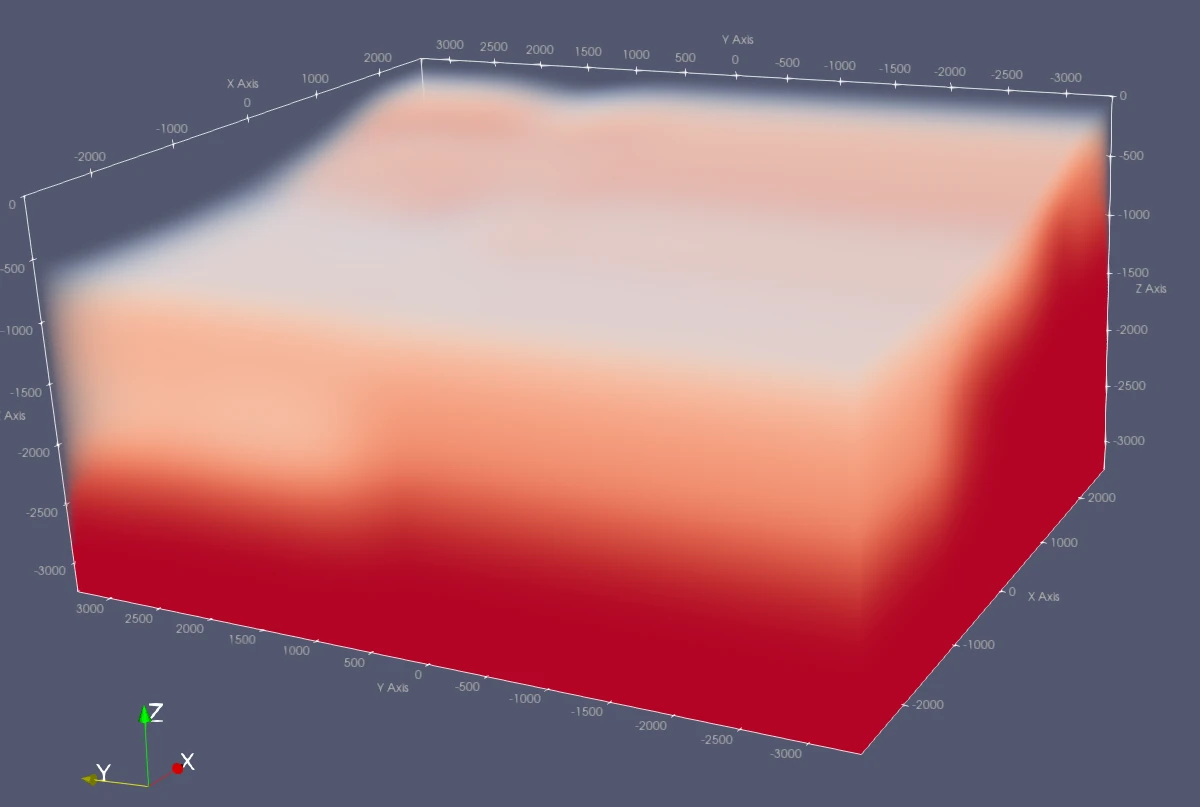
3D velocity model of the Utah FORGE geothermal test site, visualized in ParaView.