Station corrections
Station corrections add a delay to the modeled travel times of a station. They account for what the velocity model misses, e.g. the local geology below a station. Corrected travel times line up the phase arrivals better: the locations get more precise, and the stack detects more events.
| Corrections | Delay | Source |
|---|---|---|
SimpleCorrections |
Per station and phase | You give the delays |
StationCorrections |
Per station and phase (SST) | Extracted from a previous run |
SourceSpecificStationCorrections |
Per station, phase and source location (SSST) | Extracted from a previous run |
station_corrections takes the corrections, or the path to a directory with a corrections.json file.
Extract corrections from a previous run
The extracted corrections are statistics of the travel time residuals, the differences between the picked and the modeled arrival times of a previous search:
- Run a search without corrections. Its run directory holds the detections with their picks.
- Add the corrections to the configuration, with the run directory of the first search in
import_rundirs. - Run the search again. Qseek extracts the corrections when it starts and applies them to the travel times.
"station_corrections": {
  "corrections": "StationCorrections",
  "import_rundirs": ["my-search/"]
}
Constant corrections
Constant delays per station and phase, in seconds. Stations and phases without an entry are not corrected.
"station_corrections": {
  "corrections": "SimpleCorrections",
  "stations": {
    "GE.RUE.": {"cake:P": 0.12, "cake:S": 0.2}
  }
}
pydantic-model

Bases: TravelTimeCorrections
Constant travel time corrections per station and phase.
The station delays are added to the modeled travel times of all source locations.
Fields:
pydantic-field

stations: dict[NSL, dict[PhaseDescription, float]] = {}
Travel time delay in seconds per station and phase, e.g. {"GE.RUE.": {"cake:P": 0.12, "cake:S": 0.2}}. Stations and phases without an entry are not corrected.
classmethod

get_subclasses() -> tuple[type[TravelTimeCorrections], ...]
Get the subclasses of this class.
Returns:
| Type | Description |
|---|---|
tuple[type[TravelTimeCorrections], ...]
|
tuple[type]: The subclasses of this class. |
async

prepare(
    stations: StationInventory,
    octree: Octree,
    phases: Iterable[PhaseDescription],
    rundir: Path,
) -> None
Prepare the station for the corrections.
Parameters:
| Name | Type | Description | Default |
|---|---|---|---|
stations
|
Stations
|
The station to prepare. |
required |
octree
|
Octree
|
The octree to use for the preparation. |
required |
phases
|
Iterable[PhaseDescription]
|
The phases to prepare the station for. |
required |
rundir
|
Path
|
The run directory of the search. |
required |
Station-specific corrections
Station-specific corrections (SST) are one delay per station and phase, extracted from the travel time residuals of all detections of the previous runs.
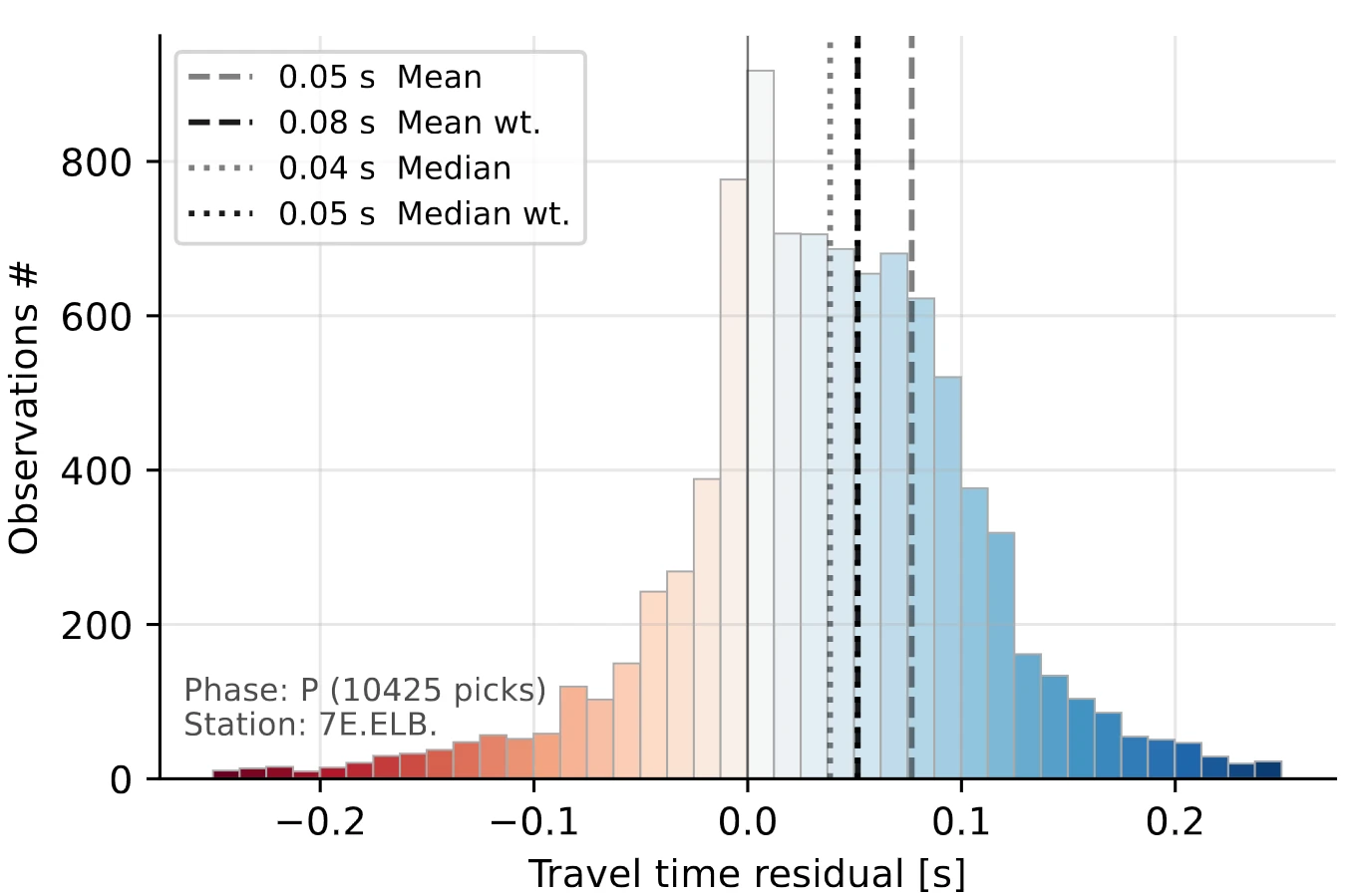
Statistics of the station delay times.
{
  "corrections": "StationCorrections",
  "import_rundirs": [
    "."
  ],
  "plot_corrections": false,
  "statistic": "median",
  "weighting": "mul-confidence-semblance",
  "min_num_station_picks": 50,
  "min_distance_border": 500.0,
  "min_num_picks": 3
}
pydantic-model

Bases: TravelTimeCorrections
Static station travel time corrections.
Fields:
-
corrections(Literal['StationCorrections']) -
import_rundirs(list[DirectoryPath]) -
plot_corrections(bool) -
statistic(ArrivalStatistic) -
weighting(WeightingMethod) -
min_num_station_picks(PositiveInt) -
min_distance_border(float) -
min_num_picks(PositiveInt)
pydantic-field

import_rundirs: list[DirectoryPath] = [Path('.')]
Path to rundir, to extract the station corrections from.
pydantic-field

plot_corrections: bool = False
Plot the station corrections statistics.
pydantic-field

Arithmetic measure for the traveltime delays. Choose from median and average.
pydantic-field

Weighting of the traveltime delays. Choose from none, confidence, semblance, add-confidence-semblance and mul-confidence-semblance.
pydantic-field

min_num_station_picks: PositiveInt = 50
Minimum number of picks at a station required to calculate station corrections.
pydantic-field

min_distance_border: float = 500.0
Minimum event distance from the border of the octree grid.
pydantic-field

min_num_picks: PositiveInt = 3
Minimum number of picks per event to be included in the statistics.
classmethod

get_subclasses() -> tuple[type[TravelTimeCorrections], ...]
Get the subclasses of this class.
Returns:
| Type | Description |
|---|---|
tuple[type[TravelTimeCorrections], ...]
|
tuple[type]: The subclasses of this class. |
get_delay(
    station_nsl: NSL,
    phase: PhaseDescription,
    node: Node | None = None,
) -> float
Get the traveltime delay for a station and phase.
The delay is the difference between the observed and predicted traveltime.
Parameters:
| Name | Type | Description | Default |
|---|---|---|---|
station_nsl
|
NSL
|
The station NSL. |
required |
phase
|
PhaseDescription
|
The phase description. |
required |
node
|
Node | None
|
The node to get the delay for. Is ignored for these median and average delays. |
None
|
Returns:
| Name | Type | Description |
|---|---|---|
float |
float
|
The traveltime delay in seconds. |
async

get_delays(
    station_nsls: Sequence[NSL],
    phase: PhaseDescription,
    nodes: Sequence[Node] = (),
) -> ndarray
Get the traveltime delays for a set of stations and a phase.
Parameters:
| Name | Type | Description | Default |
|---|---|---|---|
station_nsls
|
Sequence[NSL]
|
The stations to get the delays for. |
required |
phase
|
PhaseDescription
|
The phase to get the delays for. |
required |
nodes
|
Sequence[Node]
|
The nodes to get the delays for. Is ignored for these median and average delays. |
()
|
Returns:
| Type | Description |
|---|---|
ndarray
|
np.ndarray: The traveltime delays for the given stations and phase. |
async

prepare(
    stations: Stations,
    octree: Octree,
    phases: Iterable[PhaseDescription],
    rundir: Path,
) -> None
Prepare the station corrections for the console.
Source-specific corrections
Source-specific station corrections (SSST) vary with the source location. The delays are calculated on a grid of octree nodes, at the level set by resolution_octree_level, from the weighted travel time residuals of the events within a Gaussian sphere around each node. Between the nodes the delays are interpolated.
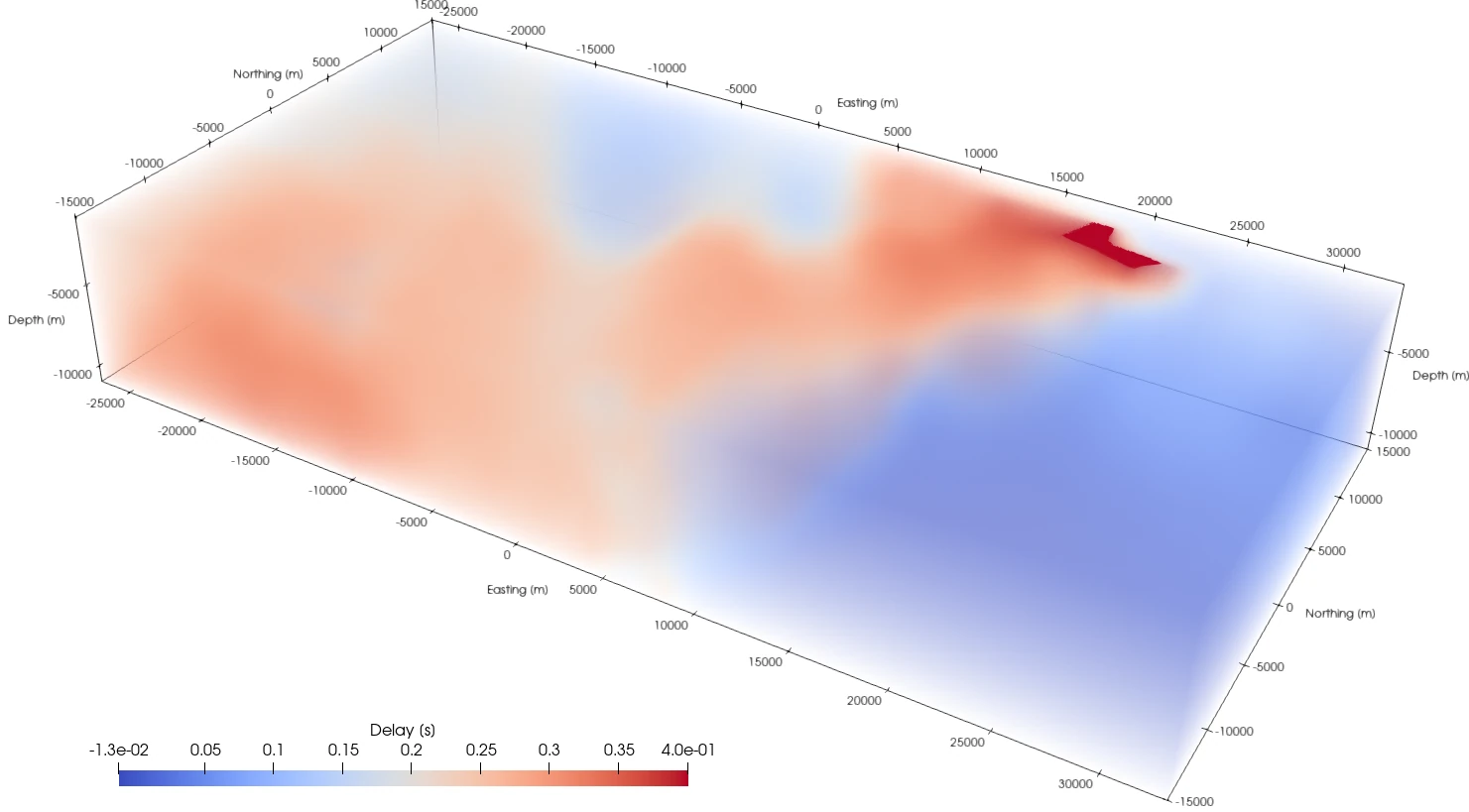
Delay volume of a single station.
{
  "corrections": "SourceSpecificStationCorrections",
  "import_rundirs": [],
  "weighting": "mul-confidence-semblance",
  "min_confidence": 10.0,
  "min_distance_border": 500.0,
  "min_num_picks": 6,
  "max_rms": 0.6,
  "spatial_weighting_exponent": 3.0,
  "resolution_octree_level": 0,
  "delay_statistic": "weighted-median",
  "delay_interpolation_method": "linear",
  "export_stations": []
}
pydantic-model

Bases: TravelTimeCorrections
Source specific station corrections, spatial travel time corrections.
Fields:
-
corrections(Literal['SourceSpecificStationCorrections']) -
import_rundirs(list[DirectoryPath]) -
weighting(WeightingMethod) -
min_confidence(PositiveFloat) -
min_distance_border(float) -
min_num_picks(PositiveInt) -
max_rms(float) -
spatial_weighting_exponent(float) -
resolution_octree_level(int) -
delay_statistic(DelayStatistic) -
delay_interpolation_method(InterpolationMethod) -
export_stations(list[NSL])
pydantic-field

import_rundirs: list[DirectoryPath]
Path to rundir, to extract the station corrections from.
pydantic-field

Weighting of the traveltime delays. Choose from none, confidence, semblance, add-confidence-semblance and mul-confidence-semblance.
pydantic-field

min_confidence: PositiveFloat = 10.0
Minimum cumulative pick confidence defining sigma of the Gaussian sphere surrouding the node. Distance sigma will start withresolution_octree_level until min_confidence is reached. Individually for each node-station combination.
pydantic-field

min_distance_border: float = 500.0
Minimum event distance from the border of the octree grid.
pydantic-field

min_num_picks: PositiveInt = 6
Minimum number of picks per event to be included in the statistics. Higher values will result in fewer events.
pydantic-field

max_rms: float = 0.6
Maximum RMS of the travel time residuals for a station to be included.
pydantic-field

spatial_weighting_exponent: float = 3.0
The exponent of the spatial weighting function around the sphere.
pydantic-field

resolution_octree_level: int = 0
The octree level (resolution) to use for the station corrections. This is the SSST grid spacing.
pydantic-field

Statistical delay aggregation method.
pydantic-field

The interpolation method to use for interpolating delays between nodes.
pydantic-field

List of station NSLs for which debug information will be generated, this includes CSV and VTK files with the station corrections and statistics about the delay
classmethod

get_subclasses() -> tuple[type[TravelTimeCorrections], ...]
Get the subclasses of this class.
Returns:
| Type | Description |
|---|---|
tuple[type[TravelTimeCorrections], ...]
|
tuple[type]: The subclasses of this class. |
load_volumes(path: Path) -> None
Load the station correction volumes (.qssst) from a directory.
Parameters:
| Name | Type | Description | Default |
|---|---|---|---|
path
|
Path
|
The path to the directory to load the station corrections from. |
required |
create_volumes(
    stations: list[tuple[Station, PhaseDescription]],
    octree: Octree,
    export_dir: Path,
) -> list[StationCorrectionVolume]
Create a new source specific station correction.
Parameters:
| Name | Type | Description | Default |
|---|---|---|---|
station
|
The station to prepare. |
required | |
octree
|
Octree
|
The octree to use for the preparation. |
required |
phase
|
The phase to prepare the station for. |
required |
Add a volume to the station corrections.
Parameters:
| Name | Type | Description | Default |
|---|---|---|---|
phase
|
The phase of the volume. |
required | |
station
|
The station of the volume. |
required | |
volume
|
StationCorrectionVolume
|
The volume to add. |
required |
get_volume(
    station_nsl: NSL, phase: PhaseDescription
) -> StationCorrectionVolume
Get the volume for a station and phase.
Parameters:
| Name | Type | Description | Default |
|---|---|---|---|
phase
|
PhaseDescription
|
The phase of the volume. |
required |
station
|
The station of the volume. |
required |
Returns:
| Name | Type | Description |
|---|---|---|
StationCorrectionVolume |
StationCorrectionVolume
|
The volume. |
has_volume(
    station_nsl: NSL | Station, phase: PhaseDescription
) -> bool
Check if the volume for a station and phase exists.
Parameters:
| Name | Type | Description | Default |
|---|---|---|---|
phase
|
PhaseDescription
|
The phase of the volume. |
required |
station
|
The station of the volume. |
required |
Returns:
| Name | Type | Description |
|---|---|---|
bool |
bool
|
True if the volume exists, False otherwise. |
get_delay(
    station_nsl: NSL, phase: PhaseDescription, node: Node
) -> float
Get the traveltime delay for a station and phase.
The delay is the difference between the observed and predicted traveltime.
Parameters:
| Name | Type | Description | Default |
|---|---|---|---|
station_nsl
|
NSL
|
The station NSL. |
required |
phase
|
PhaseDescription
|
The phase description. |
required |
Returns:
| Name | Type | Description |
|---|---|---|
float |
float
|
The traveltime delay in seconds. |
async

get_delays(
    station_nsls: Sequence[NSL],
    phase: PhaseDescription,
    nodes: Sequence[Node],
) -> ndarray
Get the traveltime delays for a set of stations and a phase.
Parameters:
| Name | Type | Description | Default |
|---|---|---|---|
station_nsls
|
Sequence[NSL]
|
The stations to get the delays for. |
required |
phase
|
PhaseDescription
|
The phase to get the delays for. |
required |
octree
|
The octree to use for the delays. |
required |
Returns:
| Type | Description |
|---|---|
ndarray
|
np.ndarray: The traveltime delays for the given stations and phase of shape is n_nodes X n_stations |