Showcase
Qseek has been used to build earthquake catalogs in tectonic, volcanic and induced settings. The case studies of Reykjanes, the Eifel and Utah FORGE are published in the Qseek paper (Isken et al., 2025); Campi Flegrei is the quick start of this documentation.
Using Qseek in your research?
We would like to show your results here. Open an issue on GitHub with a figure, a short description and the reference.
Reykjanes Peninsula, Iceland
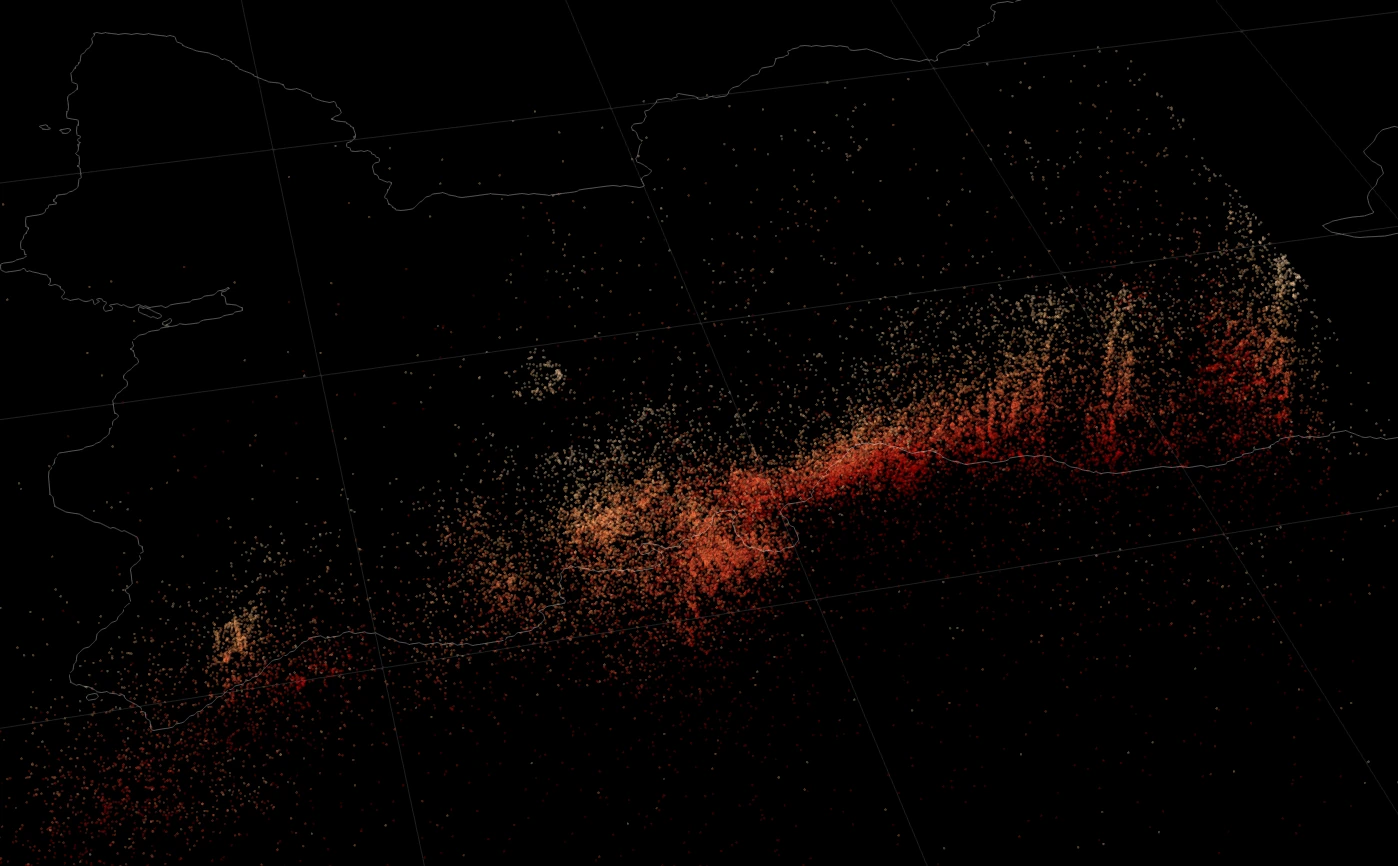
More than 30 000 earthquakes detected during the 2020 unrest on the Reykjanes Peninsula, located with source-specific station corrections (SSST). Stations of the networks 7E, 9H, SI and ZB.
The seismicity of the 2020 unrest on the Reykjanes Peninsula outlines a dike intrusion, which preceded the 2021 Fagradalsfjall eruption. The map view and the depth section show the detections, scaled by their moment magnitude.
Campi Flegrei, Italy
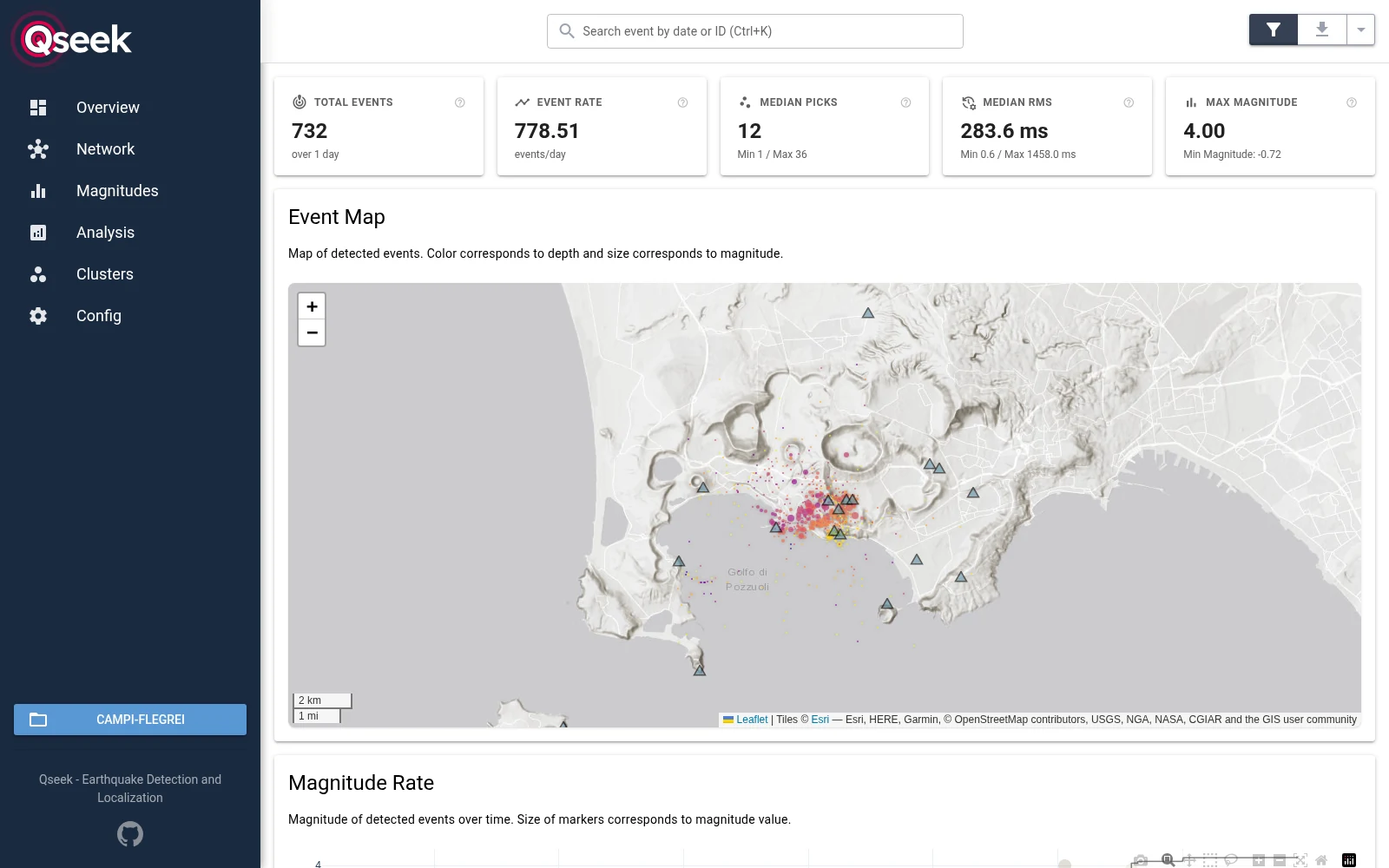
The detections of 20 May 2024 at Campi Flegrei in the Qseek web UI, colored by depth and scaled by magnitude.
On 20 May 2024, a volcano-tectonic swarm with an Md 4.4 earthquake struck the Campi Flegrei caldera. With 18 stations of the INGV network, Qseek detects 732 events on that day, including all 45 earthquakes of the INGV catalog. The quick start reproduces this search step by step.
Eifel volcanic region, Germany
Qseek detects volcanic earthquake swarms in the Eifel volcanic region.
Figure follows
A figure of the Eifel detections will be added here.
Utah FORGE, USA
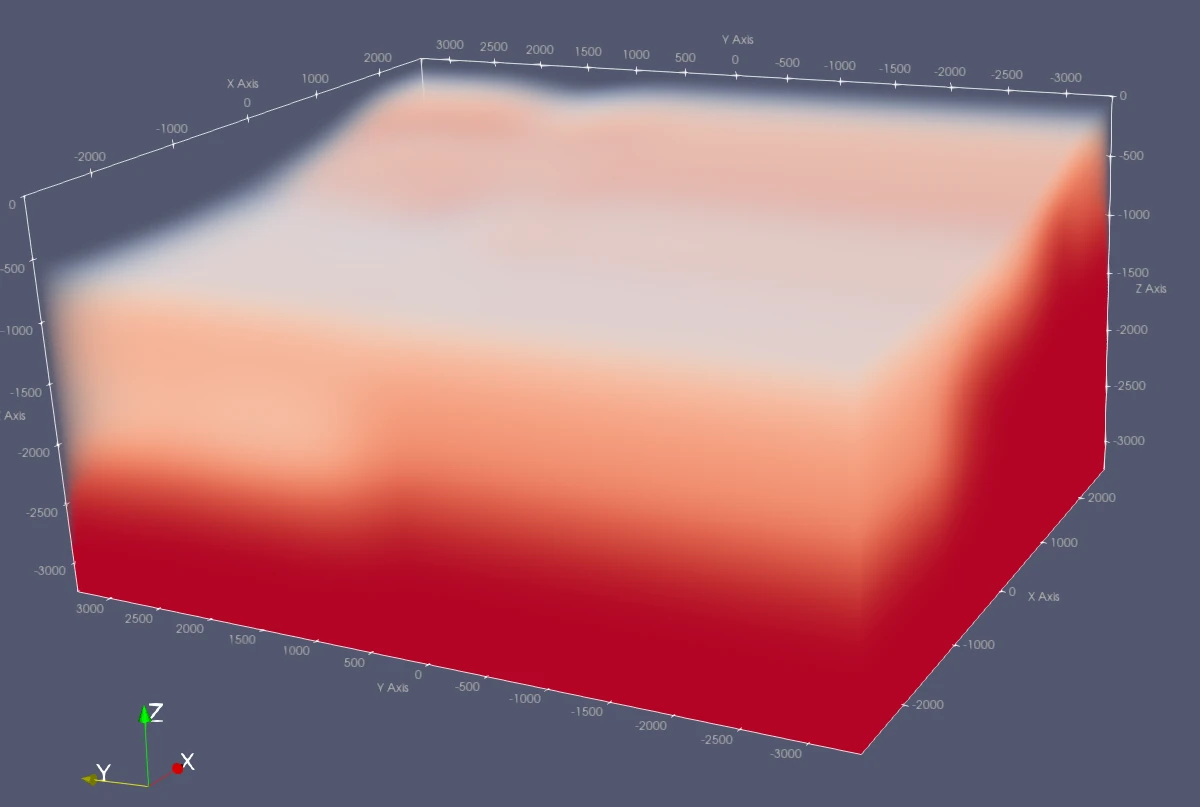
3D seismic velocity model of the Utah FORGE geothermal test site, visualized in ParaView.
At the Utah Frontier Observatory for Research in Geothermal Energy (FORGE), Qseek detects induced microseismicity. The events are located in a 3D velocity model of the site.