Distance weighting
Distance weights decide how much each station contributes to the stack of a node. The closest stations of a node constrain its location best, so they get full weight; more distant stations are tapered with a Gaussian decay. Qseek calculates a weight for every pair of station and node in the search volume, see stacking and migration.
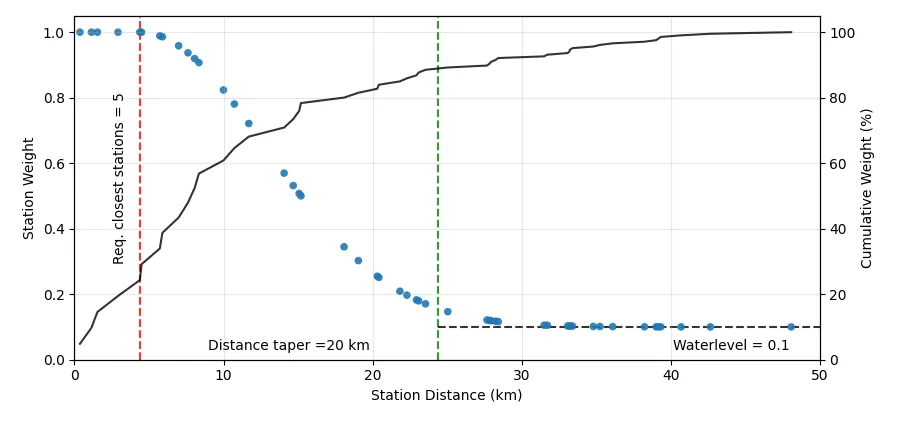
Weights of the stations for a single node (dots) and their cumulative weight (line). Three parameters shape the weights: (1) the number of closest stations with full weight, (2) the taper distance and (3) the waterlevel.
required_closest_stationsget full weight, 4 by default.distance_tapersets how fast the weight of more distant stations decays. By default it adapts to the network: twice the mean interstation distance.waterlevelkeeps a minimum weight for distant stations. With the default0.0, stations far outside the taper do not contribute.
Tip
The defaults suit local and regional networks. If distant stations should still contribute to the stack, raise the waterlevel.
{
  "distance_taper": "mean_interstation",
  "required_closest_stations": 4,
  "waterlevel": 0.0
}
pydantic-model

Bases: Model
Weights of the stations for every node of the search volume.
The closest stations of a node get full weight, more distant stations are tapered with a Gaussian decay. Close stations constrain the location of an event best.
Fields:
-
distance_taper(PositiveFloat | Literal['mean_interstation']) -
required_closest_stations(PositiveInt) -
waterlevel(float)
pydantic-field

distance_taper: (
    PositiveFloat | Literal["mean_interstation"]
) = "mean_interstation"
Distance in meters over which the weight of distant stations decays with a Gaussian function. "mean_interstation" uses twice the mean interstation distance of the network.
pydantic-field

required_closest_stations: PositiveInt = 4
Number of closest stations of a node that get full weight. Only more distant stations are tapered, so that the closest stations contribute equally and the most to the detection and localization.